
Palaestra PadelBali · 10–17 October 2026
The padel programme

Seven days.Fourteen sessions.

What happens on court during the Bali week, session by session. Three players and one coach on every court, 28 hours, and every block with a theme, a drill and a reason.

How the week is built

Build the toolkit. Rest. Then test it under pressure.

The first four days give you the tools: defence, transition, the net, the overhead. Wednesday is off so your body can absorb them. The last three days put everything back under match pressure, until the tournament on Saturday.

Days 1–4 · Build
Wed
Days 5–7 · Apply
Why three players and a coach

Your coach is the fourth player.

Three players per court, and one coach. Not so the coach can stand at the side and watch: so the coach can play. In every drill and every game, your coach is inside the rally, as the fourth player on the court.

Ball qualityEvery ball you receive comes from someone who knows exactly what you are working on: the right speed, the right height, the right level of difficulty. Not a random ball from a player having a bad day.
Always fourFour on the court at all times. Nobody sits out, nobody queues for a drill. You play every ball of your two hours.
In the gameYour coach feels the rally from the inside, and corrects you between points, while it is still fresh.
FilmedEvery session is recorded. You see yourself the same day, with your coach's notes.
A padel court from above: players one and two on one side, player three and the coach on the other3C12
Three players and the coach, all four in the rally. The coach chooses every ball.
Is this week for you

Built for players who want to break a ceiling.

  • You play regularly and you can feel you have hit a plateau.
  • You want coaching that corrects your game, not drills shared with sixteen people.
  • You want to train all week with players at your own level.
  • You are ready to work hard for seven days to make a jump your club will notice.

You do not need to be an elite player. You do need a solid intermediate base. Every place is confirmed after a short call with Florent, and he will tell you honestly if the week is not right for you yet.

5.0 · Google reviews from past Palaestra weeks

Full on sessions breaking down positioning, tactics, movement and hits. The video reviews and feedback are invaluable in accelerating the journey.

Thomas Merritt

The training was highly individualized. They took the time to identify my specific strengths and weaknesses.

Suhail Salem

If you are really focused on improving your padel game and you want to have a great time, this is the one for you.

Rob Bier
1Day

Assessment & defensive base

Saturday 10 October

Before we change anything, we watch. Day one sets your baseline and builds the foundation every other day stands on: a defence that holds.

You leave with

Your three personal themes for the week, agreed with your coach.

7 blocks · 2 game situationsSee every drill

Morning

9:00 – 11:00
Dynamic assessment rally

Cooperative cross-court rallies, forehand to forehand, backhand to backhand, then depth control. The coach reads your game before saying a word.

ConsistencyBall height & marginPositioning
Defensive structure

Your coach attacks from the net, you defend with your partner. Forehand and backhand defence, reading the glass, the quality of your defensive lob. Every ball is chosen for you.

Reading the glassDefensive lobFootwork
Defence, neutral, attack

One defensive shot, one lob, then rebuild the point. The aim is to slow the game down and win back a neutral position instead of hitting your way out.

TempoPatience
Controlled points

Every point must start with a lob or a chiquita. Short points, clear rule, first look at how you build under pressure.

Afternoon

13:00 – 15:00
Your three themes

From this morning's footage, reviewed with you over the break: what you do well, what costs you points, and the three things you work on all week.

Chiquita & transition

Start in defence, play a chiquita, move to the net. Depth and placement of the chiquita, timing of the move forward, where to stand once you are there.

ChiquitaTimingNet coverage
Level match play

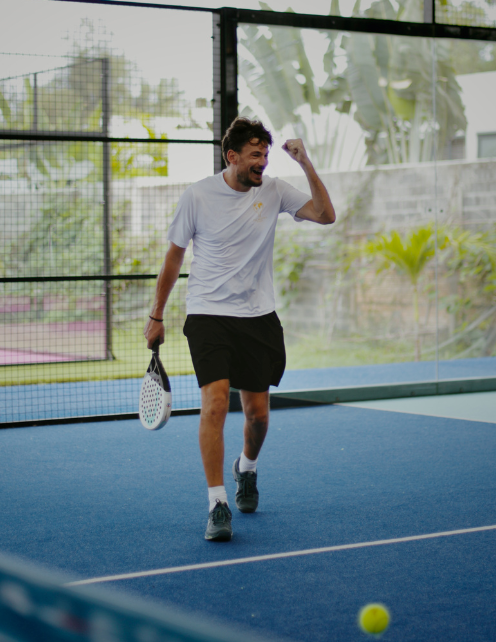
Two against two, your coach playing as the fourth. Objective: defend with intention, not with panic.
2Day

Transition: from defence to the net

Sunday 11 October

Most points at club level are lost in the few seconds between defending and attacking. Today is about owning those seconds.

You leave with

A clear rule for when to go forward, and a lob you trust to get you there.

6 blocks · 2 game situationsSee every drill

Morning

9:00 – 11:00
Activation & lob precision

Dynamic warm-up into lob targets: height, depth, direction. The lob is your ticket to the net, so it gets measured.

Lob depthTargets
When to advance

Lob, chiquita or passing shot: reading which ball lets you move forward, and which one keeps you back.

Shot selectionDecision making
Net basics

The first volley after the transition. Positioning, blocking versus accelerating, and staying balanced as you arrive.

First volleyBlock vs accelerate
Gain the net while defending

Situation game against the coach: you start at the back, the point only counts once you have taken the net.

Afternoon

13:00 – 15:00
Transition patterns

Repeat the three patterns that win the net most often at your level, until they are automatic.

Conditioned match

2 v 2, bonus points for every net taken from defence. Objective: take the net with intention.

3Day

Net control

Monday 12 October

You have taken the net. Now keep it. Today is about control at the net: when to finish, when to wait, and how not to give it back.

You leave with

Volleys that go where you decide, not just over the net.

5 blocks · 2 game situationsSee every drill

Morning

9:00 – 11:00
Volleys: control versus acceleration

Deep volleys to push back, short angles to finish. You learn which one the ball is asking for.

Volley directionDepth
Closing angles

Net positioning with your partner: moving as a pair, covering the middle, pressuring the opponent's weaker side.

Pair movementMiddle coverage
Protect the net

You start at the net, the coach attacks with lobs and low balls. Keep it for ten balls in a row.

Afternoon

13:00 – 15:00
Finishing the point

Smash, flat volley or wait for the next ball: the finishing decisions that separate a good rally from a won point.

FinishingPatience at the net
Net dominance match

2 v 2 within your group. Objective: maintain net dominance for the whole set.

4Day

The overhead game

Tuesday 13 October

The bandeja, the vibora and the smash: the shots that decide who keeps the net. And the mid-week video review of everything so far.

You leave with

A clear choice between bandeja and vibora on every high ball, and your mid-week progress review.

6 blocks · 2 game situationsSee every drill

Morning

9:00 – 11:00
Positioning under the ball

Footwork and body position for every overhead. Most overhead errors start with the feet.

FootworkPreparation
Bandeja & vibora

Height and depth to keep the net, then the vibora to put pressure on. Consistency first, then placement.

BandejaViboraPlacement
Controlled smash

When to finish, when to control, and how to manage your energy over a long match.

Overhead decisions

The coach lobs, you choose. Points scored on the quality of the decision, not only the result.

Afternoon

13:00 – 15:00
Mid-week video review

Reviewed with you over the break: days one to four side by side. What has changed, what has not yet, and what we target in the second half.

Constraint mini-tournament

Short matches with a rule per round: overhead only on high balls, net must be taken within three shots. Your toolkit, all at once.

OffRest day

Wednesday is off.

Wednesday 14 October

After four days and sixteen hours on court, you stop. No session, no drill, no alarm. This is deliberate: the technical work of days one to four only becomes yours once your body has had time to absorb it.

Go to the beach, book a massage, sleep in. You come back on Thursday fresher than you were on Tuesday, which is exactly when we raise the pressure.

16 hon court before the rest day
12 hon court after it, at match intensity
0sessions on Wednesday
5Day

The glass, at pace

Thursday 15 October

Back to defence, but faster and harder than on day one. Wall play, long rallies and low defence, now with the tools of the first half to get out of trouble.

You leave with

Calm when the ball comes off the back glass, even when the rally goes long.

6 blocks · 2 game situationsSee every drill

Morning

9:00 – 11:00
Court mobility

Split-step timing, transitions and recovery positioning. Moving well is what buys you time on every ball.

Split stepRecovery
Reading the bounce

Back glass, side glass, double glass. The coach varies speed and angle until your reading becomes automatic.

Back glassSide glassDouble wall
Low defence & legs

Play low, stay low. A heavy-legs block that builds the defence you need at the end of a long match.

Long rallies

Points only count after ten shots. Patience under fatigue.

Afternoon

13:00 – 15:00
Defence to attack, full speed

The day-one pattern again, defence, lob, rebuild, now at match pace and against tighter feeding.

Tournament situations

Matches started at 30-30 or 5-5. Every point matters, from the first ball.

6Day

Tactics & match simulation

Friday 16 October

The day we play the match before the match. Partner movement, communication, momentum, and the mental side of close games.

You leave with

A game plan with your tournament partner, and the calm to stick to it at 5-5.

5 blocks · 2 game situationsSee every drill

Morning

9:00 – 11:00
Full review

Defence, transition, net, overhead: one drill for each, to lock in the week before you compete.

Playing as a pair

Moving together, who takes the middle, what you say between points. You meet your tournament partner here.

CommunicationPair positioning
Momentum scenarios

Down 2-4, serving for the set, after a lost tie-break: the coach sets the score, you manage it.

Afternoon

13:00 – 15:00
Mental preparation

Routines between points and the reset after a mistake. Short, practical, used straight away.

Rotating match simulation

Full sets against other pairs of your level, with sparring players when needed. Objective: faster decisions under pressure.

7Day

Tournament day

Saturday 17 October

Everything, under real pressure. Control the tempo, take the net and keep it, finish points with authority.

You leave with

Your video highlights, your progress report and a plan to keep improving at home.

4 blocks · 2 game situationsSee every drill

Morning

9:00 – 11:00
Warm-up with your partner

Twenty minutes of your own patterns, set by you, checked by your coach.

Internal tournament · group stage

Pairs matched by level, short sets. Coaches and sparring players step in wherever the numbers need them.

Afternoon

13:00 – 15:00
Finals

Knock-out rounds. Apply the full structure of the week.

Closing debrief

Your day-one footage next to today's. The before and after, in your own game.

After the week

What you take home.

The week ends on Saturday. The work does not have to.

Your footage

Every session filmed. Your best clips and your key corrections, sent to you after the camp.

Your report

Where you started, where you finished, and what changed, theme by theme.

Your plan

The three things to keep working on at your club, with the drills to do it.

A follow-up call

A call with Florent a few weeks later, to check the progress has stuck.

Florent Prelot, founder and head coach of Palaestra
Who designs the week

One method. One architect.

Florent designs every session of the week and leads it on site, with the Oasis coaching team on court. One framework from day one to the final.

  • FIP #1300Ranked, and still competing
  • 100+Players coached through Palaestra programmes
  • 1 : 3One coach in the game for every three players
Before you decide

The honest answers.

What level do I need?

A solid intermediate base: you play regularly and can hold a rally. Groups are matched by level, so you never train with players far above or below you.

Will I ever wait for the ball?

No. There are always four on court: three players and your coach, who plays as the fourth. Nobody sits out a drill.

What is included?

28 hours of coached padel, courts and balls, daily video analysis, the tournament and access to the club's wellness area. Flights and accommodation are yours to arrange, which keeps you free to choose your stay.

How much is it?

€2,500 per player, coaching only, for the full week.

What happens on the rest day?

Nothing is scheduled on Wednesday 14. After sixteen hours on court your body needs it, and the second half of the week is where it pays off.

Palaestra Bali · 10–17 October 2026

This is not for everyone.
It is for you.

Nine players maximum, grouped by level. Every place is confirmed after a short call with Florent, to make sure the week fits your game.

28 h on court1 coach for 3Oasis Padel, Ungasan
Check if I qualify →Two minutes. No payment, no commitment.
Palaestra · Bali · 10–17 October 2026 · Themes adapt to each group's level after day one.